Midjourney vs DALL‑E 2026: Which AI Image Generator Wins?
In June 2026, Midjourney and DALL‑E remain the two most talked‑about AI image generators. Marketers, designers, and developers need to know which service delivers the visual fidelity, cost structure, and workflow simplicity that aligns with their projects. This guide breaks down the core differences, highlights real‑world use cases, and helps you decide which tool fits your creative pipeline. All information reflects publicly available pricing and feature sets as of 2026.
What You Will Find in This Guide
Jump to any section — features, pricing, use cases, comparisons, community insights, and FAQs.
What Is Midjourney and What Does It Do?
Midjourney is an AI‑driven image synthesis platform that operates through a Discord‑based prompt interface, leveraging a proprietary diffusion model launched in 2025. DALL‑E, from OpenAI, offers a web‑app and API that generate images from textual prompts using the third‑generation diffusion engine. Both belong to the AI Image Generation category, but Midjourney emphasizes artistic stylization while DALL‑E focuses on photorealism and broader content safety. Midjourney was founded by an independent research lab, whereas DALL‑E is a product of OpenAI, a publicly listed AI leader.
Who Uses Midjourney in 2026?
- Creative Director: Leverages Midjourney for rapid mood‑board creation, iterating on visual concepts in real time during client workshops.
- Product Designer: Uses DALL‑E to generate high‑resolution mockups that can be directly exported into design tools for UI prototyping.
- Content Marketer: Runs batch prompts in DALL‑E’s API to produce blog‑post illustrations that match brand guidelines without licensing concerns.
- Game Artist: Employs Midjourney’s stylized output to inspire concept sketches for characters and environments before hand‑crafting assets.
- Projects that require strict brand‑color compliance without manual post‑processing.
- Teams that need on‑premise deployment for data‑privacy reasons, as both services are cloud‑only.
Midjourney Features That Matter for Your Workflow
Natural‑language prompt syntax with style modifiers
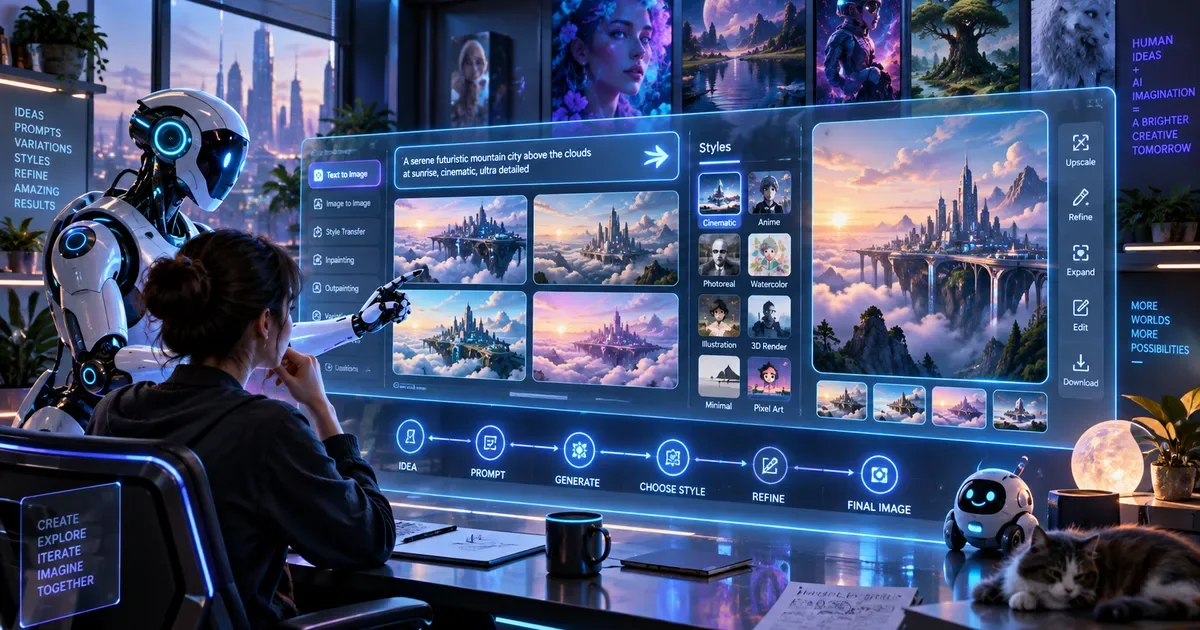
Midjourney’s Discord bot accepts concise prompts enriched with style tags, letting artists embed references like "cinematic lighting" or "low‑poly". DALL‑E’s web UI offers a guided prompt builder that suggests attribute options, reducing guesswork for marketers. Both approaches accelerate ideation by turning text into visual drafts within minutes.
Workflow outcome: Faster concept iteration without needing a graphics specialist.
High‑resolution output for production‑ready assets
DALL‑E 3 natively supports up to 1,024×1,024 pixels, while Midjourney’s Pro plan unlocks 2 K‑scale renders via upscaling jobs. Teams can choose the service that matches their final‑output requirements—print‑grade versus web‑only.
Workflow outcome: Eliminates the need for third‑party upscalers in most cases.
Built‑in content moderation to prevent policy violations
OpenAI embeds a multi‑layer safety system that blocks disallowed subjects in DALL‑E. Midjourney provides a community‑moderated filter but allows more artistic leeway, which can be a double‑edged sword for brand‑sensitive work.
Workflow outcome: Reduced risk of generating non‑compliant imagery.
Real‑time sharing and feedback loops
Midjourney’s Discord channel doubles as a collaboration hub where teammates can view, react, and remix images instantly. DALL‑E offers shared folders and version history in its web app, supporting remote design reviews.
Workflow outcome: Streamlined stakeholder approvals.
Programmatic generation for scaling workflows
Both platforms expose RESTful APIs; DALL‑E’s API includes usage‑based pricing and fine‑grained controls, while Midjourney’s beta API is limited to Pro users but offers faster queue times. Developers can embed image generation into CI pipelines or content pipelines.
Workflow outcome: Automation of bulk asset creation.
Extensive public galleries for inspiration
Midjourney’s community feed showcases millions of user‑generated prompts, serving as a living style library. DALL‑E’s showcase is curated by OpenAI, highlighting commercial‑grade examples. Both resources help new users learn effective prompt engineering.
Workflow outcome: Shorter learning curve for novice creators.
Real-World Use Cases in 2026
Brand Campaign Concepting
A global agency runs Midjourney in a private Discord server to spin up 30 visual concepts for a product launch in under an hour, then refines the winning ideas in Adobe Photoshop.
E‑commerce Product Visualization
An online retailer uses DALL‑E’s API to generate lifestyle images for new SKUs, feeding the results directly into Shopify’s product pages via a Zapier integration.
Game Asset Ideation
Indie developers prompt Midjourney for concept sketches, then export the high‑resolution outputs to Unity as reference textures for low‑poly modeling.
Educational Illustrations
A university’s online course team leverages DALL‑E to create custom diagrams for lecture slides, ensuring each visual aligns with accessibility standards.
Midjourney Pricing in 2026 — What You Pay
Midjourney offers three tiers: a free trial limited to 25 generations, a Basic plan at $10 / month for 200 images, and a Pro plan at $30 / month with unlimited fast‑mode generations and higher‑resolution upscales. DALL‑E provides a free credit bundle each month (about 15 generations) and a Pay‑As‑You‑Go model at $0.20 per image, plus a $15 / month subscription that adds 115 credits and priority access. Neither platform charges hidden fees, but high‑volume users should monitor credit consumption and API rate limits.
| Plan | Price | What You Get |
|---|---|---|
| Free Trial | Free | 25 image generations, community gallery access |
| Midjourney Pro Best Value | $30/month | Unlimited fast‑mode generations, 2 K upscales, priority Discord support |
| DALL‑E Pay‑As‑You‑Go | $0.20 per image | Credits purchased on demand, API access, commercial usage rights |
Check the latest Midjourney pricing →
Midjourney Honest Pros and Cons in 2026
- Artistic StylizationMidjourney excels at producing painterly, surreal, and highly stylized outputs that stand out in creative briefs.
- Photorealistic FidelityDALL‑E delivers consistently realistic textures and lighting, ideal for product mockups.
- Community CollaborationMidjourney’s Discord environment fosters instant feedback and remixing.
- API FlexibilityBoth platforms provide robust APIs, but DALL‑E’s usage‑based pricing scales predictably for enterprises.
- Safety ComplianceOpenAI’s multi‑layer filters reduce risk of policy‑violating content.
- Learning CurveMidjourney’s Discord commands can be unintuitive for non‑technical users.
- Resolution LimitsMidjourney’s native output caps at 1 K unless upscaled, which adds extra steps.
- Cost PredictabilityDALL‑E’s per‑image pricing can become expensive for large batches.
- Brand ConsistencyBoth models may produce color shifts that require manual correction.
- The DealbreakerNeither service offers on‑premise deployment, which disqualifies them for highly regulated industries.
How to Get Started With Midjourney in 2026
Create an account on the Midjourney website and join the official Discord server; you’ll receive a welcome channel with usage guidelines.
For DALL‑E, sign up via OpenAI’s portal, claim your free monthly credits, and generate your first image through the web UI to familiarize yourself with the prompt builder.
Draft a concise prompt using style tags (e.g., "cinematic lighting, ultra‑detail") and submit it in Midjourney’s #new‑bies channel or DALL‑E’s prompt box.
Review the generated variations, select the best, and use the upscaling command (Midjourney) or the “Edit” feature (DALL‑E) to refine details.
Export the final PNG or JPEG, then integrate it into your design system, content calendar, or development pipeline.
Track credit usage or generation count in the account dashboard to ensure you stay within budget and plan upgrades if needed.
What Real Users Say About Midjourney
These insights are synthesised from community discussions, forum threads, product reviews, and market conversations — not fabricated. They capture recurring themes from real users in the market.
Teams that tap into the Discord remix workflow report 30 % faster concept finalization, because peers can instantly tweak prompts and share results.
Marketers note occasional false positives when generating industry‑specific equipment, prompting a need for manual prompt adjustments or appeal tickets.
Compliance officers advise evaluating a self‑hosted diffusion model if data residency is a strict requirement.
Midjourney vs the Competition
| Decision Area | Midjourney | When Another Option Wins |
|---|---|---|
| Best suited for | Creative teams that need stylized, concept‑driven visuals | DALL‑E – when photorealism and strict safety compliance are top priorities |
| Pricing position | Midjourney offers a low‑cost unlimited tier for heavy users | DALL‑E – pay‑as‑you‑go works better for occasional creators |
| Primary differentiator | Discord‑centric collaborative workflow | DALL‑E – higher native resolution and robust API |
| Ease of onboarding | Midjourney requires Discord familiarity | DALL‑E – web UI is beginner‑friendly |
| Team collaboration | Live prompt sharing in Discord channels | DALL‑E – shared folders and version control |
| API and integrations | Midjourney’s beta API for Pro users | DALL‑E – mature SDKs and Zapier/Make connectors |
| Long-term scaling | Predictable flat‑rate Pro plan | DALL‑E – usage‑based pricing scales with enterprise budgets |
Midjourney vs Stable Diffusion
Stable Diffusion is an open‑source model that can be self‑hosted, giving full control over data and costs. It requires technical expertise to set up, but large enterprises value the privacy and customization it provides.
Choose Midjourney if: You need a managed service with community support and no infrastructure overhead. Choose Stable Diffusion if: Data residency or custom model training is a non‑negotiable requirement.
Midjourney vs NightCafe
NightCafe offers a credit‑based marketplace and a simple web UI, making it easy for hobbyists. However, its output quality trails both Midjourney and DALL‑E on complex prompts.
Choose Midjourney if: Your team demands higher fidelity and collaborative features. Choose NightCafe if: You prefer a low‑commitment, credit‑only pricing model for occasional art.
Midjourney — Frequently Asked Questions
How does Midjourney work exactly?
Midjourney runs a proprietary diffusion model accessed via Discord commands. Users type a prompt, optionally add style tags, and the bot returns four variations. Upscaling and remixing are available through additional commands. Midjourney review details the workflow.
Is DALL‑E free or does it require a subscription?
DALL‑E provides a monthly free credit bundle (≈15 images). Beyond that, users can purchase additional credits at $0.20 per image or subscribe for $15 / month, which adds 115 credits and priority access. The free tier is sufficient for light experimentation, but power users typically opt for the subscription.
What are the best alternatives to Midjourney in 2026?
Stable Diffusion offers self‑hosted flexibility; NightCafe provides a low‑commitment credit system; DreamStudio (the official Stability AI UI) balances ease of use with higher resolution outputs. Choose Stable Diffusion for data‑sensitive projects, NightCafe for casual creators, and DreamStudio for higher‑resolution needs without a subscription.
Who is Midjourney best suited for?
Midjourney shines for concept artists, game designers, and marketing teams that thrive on rapid visual brainstorming and community feedback. Its stylized output is ideal for mood‑boards, storyboarding, and early‑stage creative exploration.
Does DALL‑E integrate with other tools?
DALL‑E’s API integrates with Zapier, Make, Adobe Photoshop plugins, and major CMS platforms via REST endpoints. These connectors enable automated image generation for e‑commerce listings, social media scheduling, and design system updates.
Key Takeaways
- Midjourney and DALL‑E are leading AI image generators that differ in style focus and pricing models.
- Creative teams benefit most from Midjourney’s collaborative Discord workflow, while product teams favor DALL‑E’s photorealism and API ecosystem.
- Both platforms offer free tiers, but Midjourney’s $10 / mo Basic plan and DALL‑E’s $15 / mo subscription are the entry points for serious usage.
- Midjourney’s biggest strength is its artistic stylization and community remix loop.
- The biggest limitation for both is the lack of on‑premise deployment, which can block regulated industries.
Best Midjourney Alternatives Worth Considering
- Stable Diffusion — Self‑hosted, customizable diffusion model ideal for enterprises with strict data policies.
- NightCafe — Credit‑based pricing and simple web UI, perfect for hobbyists and occasional creators.
- DreamStudio — Official Stability AI interface offering higher resolution outputs and flexible pay‑as‑you‑go credits.
- Deep Image AI — Specializes in upscaling and enhancing generated images, useful when native resolution falls short.
Bottom Line: Is Midjourney Worth It in 2026?
Bottom Line: Midjourney is the go‑to choice for teams that value artistic flexibility, community collaboration, and predictable flat‑rate pricing. DALL‑E wins for photorealistic needs, robust API support, and tighter safety controls. If on‑premise deployment or strict data residency is essential, look to self‑hosted alternatives like Stable Diffusion.
Explore Midjourney Today →
Last Updated: June 2026 | Written by theaitoolsbox.com editorial team